The PEACE Communication Passport helps a person share important information about themselves with the people involved in their care. This guide explains how to complete a passport and how to keep it up to date.
What the PEACE Communication Passport is
A Communication Passport is a record the person fills in about themselves. It covers how they communicate, their sensory needs, what helps them and what they find difficult.
Repeating the same information to every new professional can be tiring and stressful. The passport means the person only needs to explain things once. Anyone assessing or treating them can read it first.
The passport was developed with autistic people in mind. It can be useful for anyone who needs ongoing care and support.
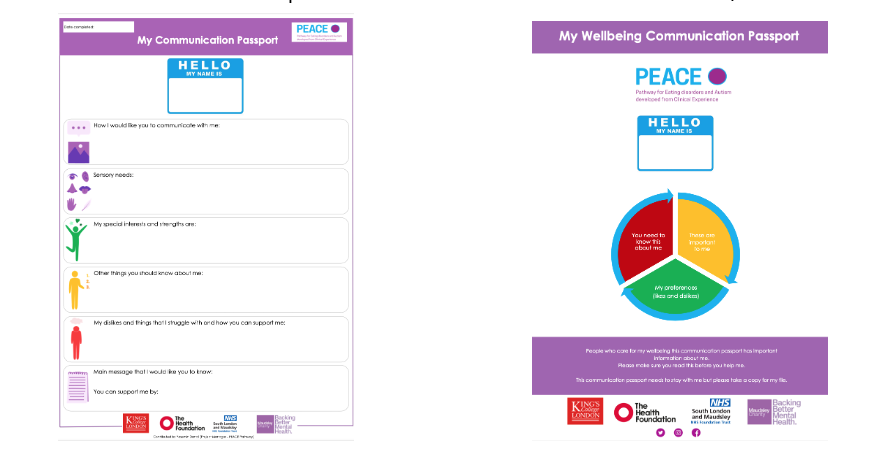
Choosing a version
There are two versions. People can choose which one suits them.
- The one page version is short and quick to complete. It works well as a starting point, for example before or during a first appointment.
- The full version goes into more detail. It includes sections on wellbeing, a support plan and a relapse prevention plan.
Completing the passport
Clinicians should offer the passport early in care, ideally at or before the first appointment. Some people like to fill it in on their own. Others prefer to complete it with a clinician or someone they trust.
Every section is optional. The person can fill in as much or as little as they want, and come back to it later.
Keeping it with the person
The passport belongs to the person, and the original stays with them. With their agreement clinicians should:
- Upload a copy to the service’s electronic records
- Keep a printed copy where staff can easily find it, such as the nursing office on a ward
Reviewing and updating
Needs and preferences can change during treatment. The person can update any part of their passport at any time.
Clinical teams should check in about the passport at regular points, such as care reviews, to ask whether anything has changed and whether the adjustments are still helping. When the passport is updated, make sure that everyone involved in delivering care has access to the latest version.
RELATED PUBLISHED RESEARCH
- Li, Z., Chubinidze, D., Croft, P. et al. “Don’t talk to me like I am an illness”: exploring patients’ needs using the communication passport in an eating disorder service. Neuropsychiatr 39, 28–35 (2025). https://doi.org/10.1007/s40211-024-00501-7